
Deployment and boundary
Platform
On-prem at the facility by default. Adapter profiles for country specifics. A public site that does not sit inside the clinical boundary.
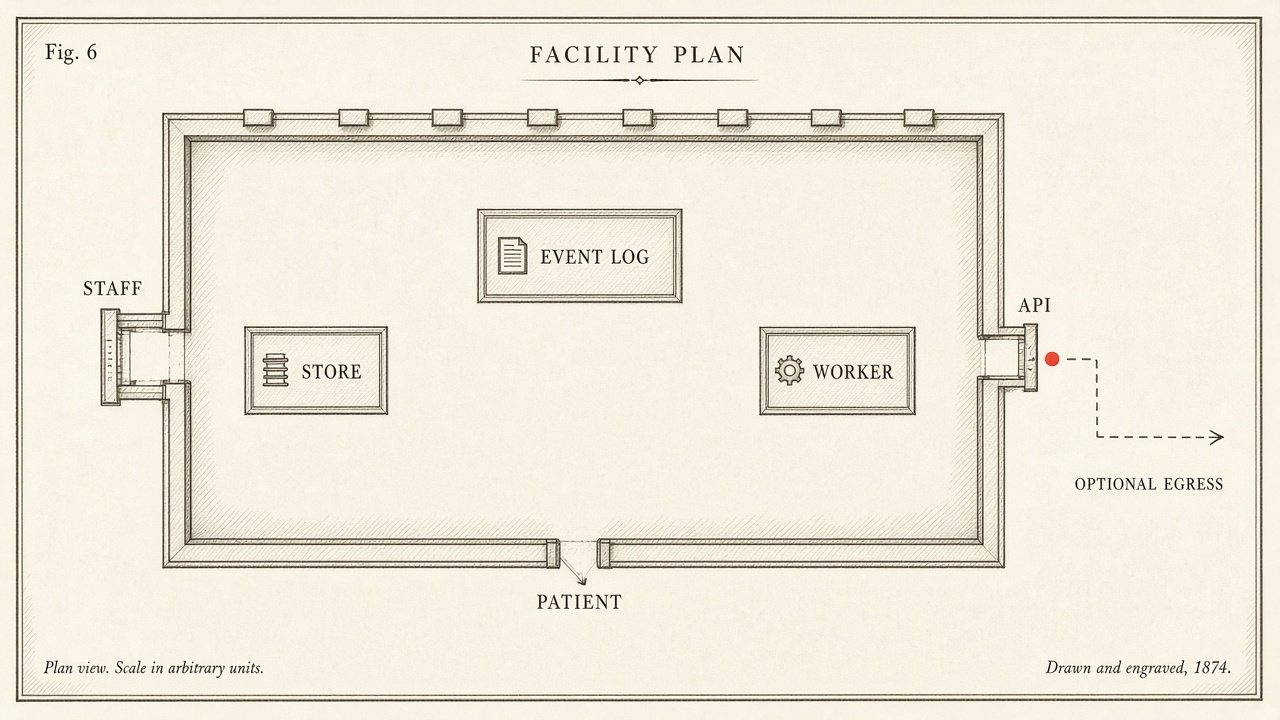
Beys runs on the facility's own servers by default. GPU is optional. Cloud is a secondary variant. Data residency is a feature.
What faces the network
Ingress exposes the API, the staff web, and the patient web.
Stores stay inside the boundary: the event log, the database, object storage, and imaging.
This public site is a separate origin. It does not proxy GraphQL. It does not read charts. It does not share a cookie jar with the clinical apps.
Adapters, not hardcodes
Country specifics are adapter profiles:
- payer
- identity document
- language
- guideline pack
- notifiable-disease reporting
A worked payer profile is not the market. The product is global, with a Malaysia and emerging-high-growth-nation lead.
Operability
The clinical record is event-sourced. Rebuilds are an operations path, not a myth.
The IT administrator bootstraps an organization, a facility, and the first administrator. That role has no PHI by construction.
Optional council or note-generation APIs can egress if the facility configures them. On-prem sets egress near zero. It is not an absolute "PHI never leaves the building" slogan. Do not say that sentence.